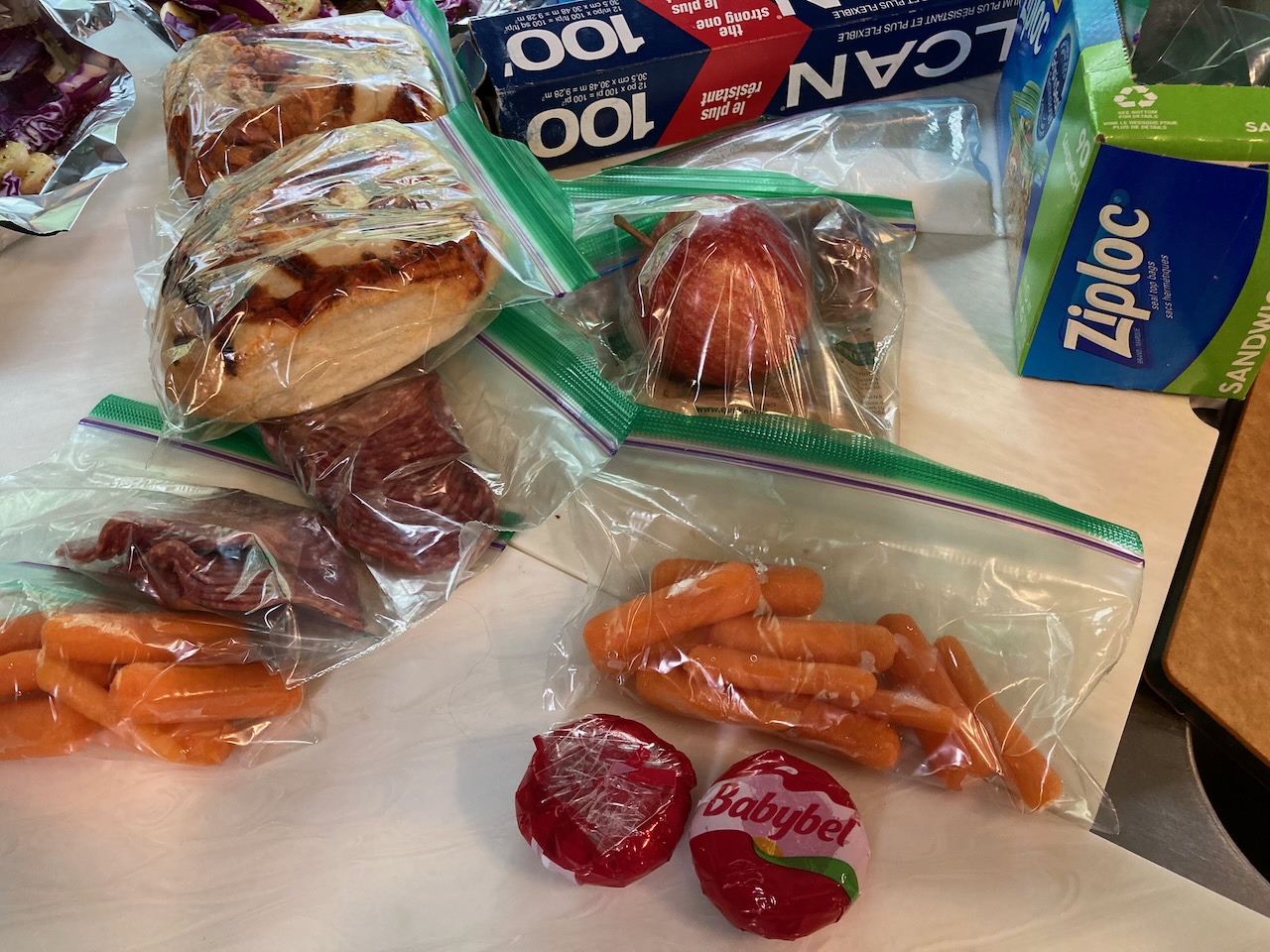
Figuring out what kind of food to pack for a backpacking trip can be difficult. You want food that won’t be too heavy in your backpack but you also want the food to be enjoyable and satisfying.
And then there’s the challenge of figuring out how much to pack. You don’t want to go hungry but you don’t want to overpack and end up carrying a bunch of extra food out with you.
Figuring Out How Much Food You Will Need
When planning how much food to bring, I tried to estimate how many calories I would be burning each day. I figured roughly 3,000 calories per day. Turns out, I was a little low. After the trip, my Fitbit said I burned 2,758, 2,912, and 3,178 calories on each of the three days respectively. However, Fitbit calculations are based on just walking. It didn’t account for the heavy pack I was carrying. A more accurate estimate for me would probably be around 3,250 calories per day.
There are other factors that drive food consumption on a backpacking trip besides calories burned. I have found that in the first few days, it can be very difficult to eat much. As my body adapts to carrying a heavy pack and walking each day, it doesn’t want to take in much nutrition. On those days, I burn a lot more than I consume.
That comes back on Day 4 or 5 when I start to become very hungry. Then it’s much easier to eat. If I overpack food for the first few days, I just end up carrying it. It doesn’t get eaten.
For this three day trip, I designed the backpacking menu with about 2,500 calories per day. I wasn’t worried too much about eating less than I was burning because I was only out for three days and I knew I could make up for it when I got home. Also, I knew my body wouldn’t be ready to start eating more during those three days.
What Kind of Food to Bring
I’ll give you a run down here of the kinds of foods I like to bring and then a list of everything I decided to include for the three-day Elbow Loop.
A good rule is to try food at home before you take it out with you so you don’t end up with food you don’t like or can’t tolerate. However, it is important to realize that food you crave when you are backpacking could be different than the food you eat at home. For example, at home I often have a salad and protein for dinner, like a caesar salad with grilled chicken. On the trail, I crave starches such as bread, mashed potatoes and pasta. That food tastes better out there.
Fresh Fruit and Vegetables
I included more fresh food on this trip than I would for a longer trip. Fresh fruits and veggies taste so good outside, especially when you’re active. They are very heavy though so I usually only pack enough for the first two or three days of a longer trip. Dried fruit such as apricots, mangoes and apples typically keep well in the backpack for longer trips.
Protein
I find that at home, dinners are planned around a protein, whether it’s meat, chicken, fish or a vegetarian protein. However, on the trail, it’s hard to consume dehydrated proteins beyond a small amount. I find they aren’t tasty and they’re very dense.
I usually bring sausage, such as salami, and cheese. These foods last quite a while without refrigeration in the Canadian Rockies where it gets pretty chilly at night. They seem to keep better in their original packaging so I try not to unwrap them until I am ready to eat them.
Pre-cooked bacon does not require refrigeration and actually tastes pretty good.
Starches
I plan my backpacking dinners around starches because that’s what I feel hungry for when I’m out there. Food such as pasta, rice, and instant mashed potatoes form the basis for my evening meals. I try to buy packets that are just-add-water, like instant mashed potatoes, or have a short cook time like Ichiban noodles.
It’s hard to cook meals on the Jet Boil stove. I find it difficult to get food to simmer. I either have it at a full rolling boil or off.
Rice and pasta dishes from Lipton or Knorr, typically sold as side dishes, make good backpacking meals. Some of these include small amounts of dried veggies which can be a nice addition.
Pasta dishes such as Annie’s are pretty good. If the meal requires milk, I pack some powdered milk to stir in or make it just with water. I like instant oatmeal for breakfast.
Beverages
I like to add juice crystals with electrolytes to flavour my water. Water treatment tablets can add a bad taste that is hard to drink and the flavouring helps with that. Also, I find it easier to drink more water out there when it’s flavoured. The electrolytes are probably not necessary but in case they’re helpful, I use them.
I have experimented with different ways to make good coffee and I always come back to a good quality instant coffee. It’s lightweight and simple. Try different brands at home to see what works best for you.
Tea and sugar are lightweight and I find them a comforting drink in the evening. Hot chocolate has more calories but it’s a lot heavier. I pack one per day if I pack it all.
Instant chicken soup (Cup of Soup) is something I cannot do without and I like to make it as soon as I’ve arrived at camp. I set up my tent and sleeping pad, unroll my sleeping bag and then make a Cup of Soup. It’s salty and warm and always makes me feel better.
Freeze Dried Food
You can buy good quality freeze-dried meals at most camping and outdoor stores. I enjoyed them when I first started backpacking but I seemed to reach some sort of internal limit where I could no longer stomach them. I lost some weight on one trip because I couldn’t choke down the dinners. Since then, I try to pack grocery store food as much as possible.
Here’s the backpacking menu. Note that breakfasts, lunches, snacks and drinks are the same everyday.
DAY 1
breakfast
- at home before heading to the trail
lunch
- pizza bun from bakery
- sliced salami
- carrot sticks
- Babybel cheeses
dinner
- instant mashed potatoes
- cup of soup
snacks and desserts
- Kit Kat chunky bar
- Made Good granola bar
- bakery oatmeal raisin cookies
- dried mangos
- almond M&Ms
drinks – same everyday
- instant coffee
- Skratch electrolyte juice crystals
- hot chocolate
- tea
- sugar for tea
DAY 2
breakfast
- instant oatmeal packet
- fresh apple
- pre-cooked bacon
lunch
- pizza bun from bakery
- sliced salami
- carrot sticks
- Babybel cheeses
snacks and desserts
- Kit Kat chunky bar
- Made Good granola bar
- bakery oatmeal raisin cookies
- dried mangos
- almond M&Ms
dinner
- instant mashed potatoes
- cup of soup
DAY 3
breakfast
- instant oatmeal packet
- fresh apple
- pre-cooked bacon
lunch
- pizza bun from bakery
- sliced salami
- carrot sticks
- Babybel cheeses
snacks and desserts
- Kit Kat chunky bar
- Made Good granola bar
- bakery oatmeal raisin cookies
- dried mangos
- almond M&Ms
dinner
- at home – a glorious celebration meal complete with glass of wine
Post-trip Notes
I sometimes didn’t finish breakfast or lunch food until dinner time. Sometimes some of the snacks or desserts became part of breakfast or lunch. I ate what I felt like eating and didn’t get too focused on what was supposed for be for breakfast or lunch.
Of course, I shared all of my food with Peaches except for the raisin cookies and the chocolate (these are not good for dogs). She ate a fair amount of my food and hardly any of the dog food I packed for her.
We finished off most of the food for Day 1 on Day 1. I carried forward the Kit Kat bar. I ate it on Day 2 along with everything I packed for Day 2 except the oatmeal raisin cookies. On Day 3, we only ate about half of the lunch and snacks. I had my head down and was hiking for home.

Learn about my trip
See more:
Leave a Reply