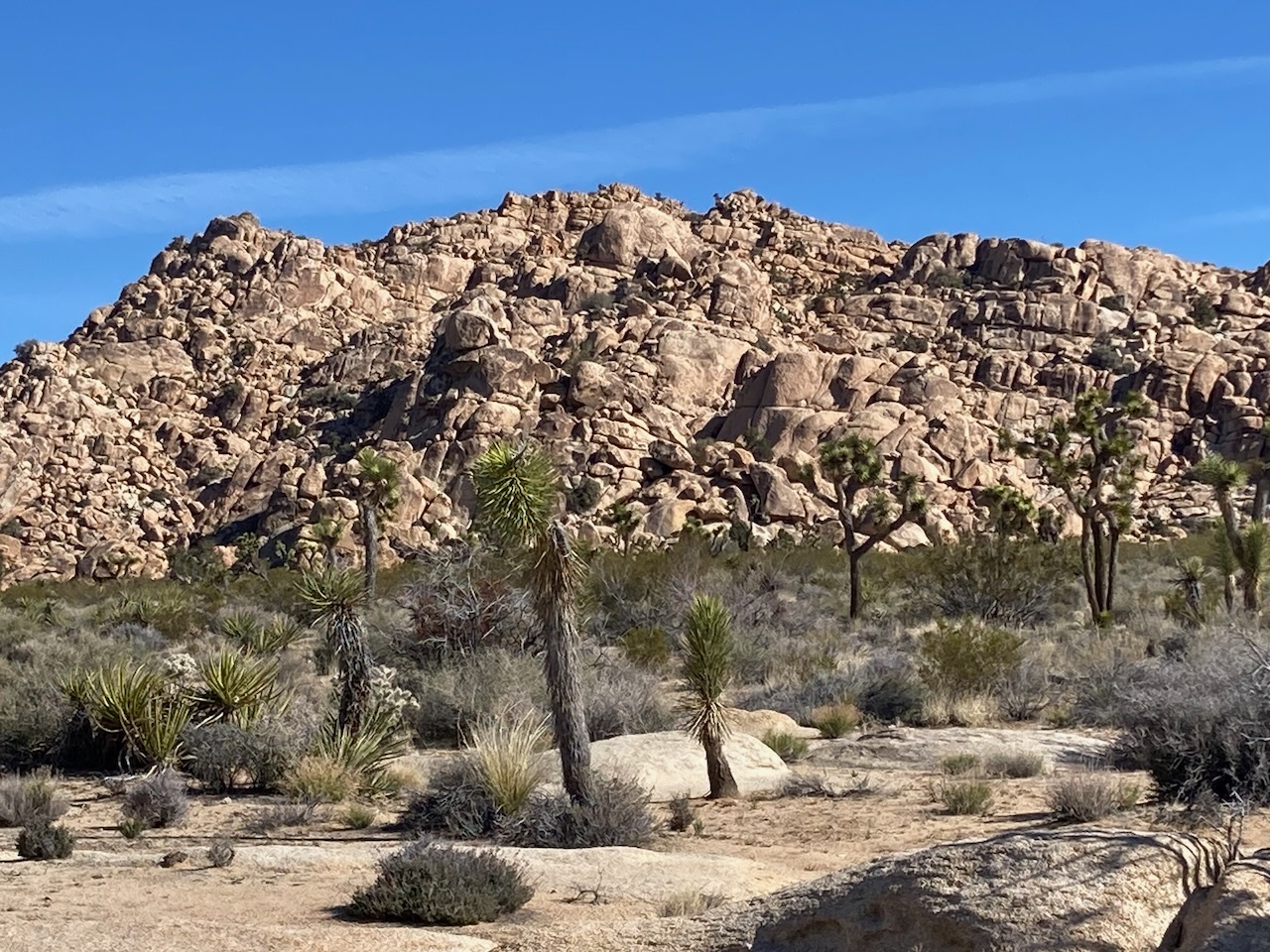
Ah the names people gave these climbing areas.
Outer Mongolia, the area where the Asian Fever Buttress is located, is a further walk out in the desert. I measured it as 3.6 km from the trailhead. But on a smooth, mostly well-defined trail with no steep hilly sections, it’s still a pretty easy approach compared with what we have at home.
Asian Fever Buttress
We had hiked to this area and checked out these climbs on our last visit in 2023. The obvious cracks splitting the slab and running most of the length of the wall looked pretty enticing.

The crack Dan climbed
I climbed here
Being a holiday (Good Friday), we assumed the easily accessible climbing areas would be busy. We wanted to climb somewhere more remote.
There are four climbs here rated 5.4, 5.5, 5.6 and 5.7. The 5.7 is a sport climb meaning it had bolts that you clip and you do not need to place gear.
Dan was interested in the 5.5. In the photo above, it is the long curving crack that starts just above the bottom blotchy area and goes all the way to the top, splitting the rock at the top into two big chunks.
I wanted to start with leading the 5.4. In the photo above, it starts on the vertical crack on the right, then moves left (at the words “I climbed here”) to another vertical crack. At the top of that crack, it goes left across a ramp and up the slab into another crack that leads to a ledge. From the ledge, there is one last crack to the top.
I thought I would easily lead this climb and then do the 5.5. If I had energy left after that, I planned to try the 5.6.
So ambitious. So naive.
Approach
The hike to the climbs is long but straightforward.
We started on the Boy Scout Trail, as we’d done a few times already on this trip. This time, we kept going past Outward Bound Slab, past Mustang Ranch, past Bear Island.
Eventually, the trail forks with the Boy Scout Trail going left and the Willow Hole Trail going right. We branched onto Willow Hole and could see our climbing area in the distance.
Once we got close, we left the main trail and tried to find a side trail through the desert. The trails we found petered out and we went cross country for some of the approach.

The Asian Fever Buttress is in the middle of the photo. It is a shorter formation with smooth rock on the left side. This is where the climbs are.
We got to a sandy wash that runs toward the climbs. We hiked up the wash to the base of a boulder field. There we climbed and scrambled over boulders to reach the base.

We stopped at the bottom of the 5.4 and set up for climbing. It was my turn to lead first and I eagerly checked out the 5.4.
It looked like a fun adventure, meandering across the wall, joining different cracks and ledges. I was more excited than nervous when I started.
Section One – Bottom Half Cracks
I climbed the first crack confidently and felt good about the few pieces of gear I placed. Once again, I had loaded up my harness with way more gear than I would ever need. This made it more heavy but it also ensured that I could place as much gear as I needed to feel comfortable.
At the top of the first crack, there was a steep rock face. I needed to move to the left, across a slab that seemed to lack any features for footholds. Perhaps if I could get solid hands on the rock face, I could shuffle my feet across and hold on if my feet slipped.
The rock face had a thin crust covering the lower parts, and the top edge of the crust could provide a hold for fingertips. However, when I tapped on the crust, it sounded brittle. When I grasped it, digging my fingertips as far back into it as I could, it felt like it might crumble. I didn’t trust it to hold my weight.
(Dan later told me that when he climbed this section, he tried to use the crust for a handhold and it broke off.)
But with no handholds and no features on the slab for my feet, I couldn’t figure out how to get across. I placed a piece of gear at the top of the crack and asked Dan to lower me.
I was planning to lower to the ground and quit. Tired from the battle at Chicken Ranch the day before, I felt like I didn’t have it in me to finish this climb.
As I was lowered, I looked up at the challenging section. I noticed features lower down on the slab that could be used as footholds. I asked Dan to stop lowering me and I hung there, studying the features. If I moved across the slab lower down, I might be able to do it. I decided to go back up and try it.
I was able to find footholds and moved up and over enough to get my hands into the bottom of the second crack. Then I started climbing again. I got up onto the first ledge. It was flat enough to walk up.
That was when I started noticing the rope drag. Ideally, the rope runs in a straight line between the climber and the belayer on the ground. If the route traverses or zigzags, the bend in the rope makes it hard for the climber to pull as she climbs.
I had clipped the rope to a piece of gear at the top of the first crack, creating a sharp bend as the rope ran across to the second crack. I had to pull hard on the rope as I walked up the ledge.
Section Two
Here I started to get confused. I thought the route went up slab to the bottom of another crack. But this section looked pretty scary up close. Nothing to hold onto or step onto for the two body lengths distance to the crack.
I walked past the slab to where a crack spilt a steeper bulge of rock. There were some features to hold around the crack but no footholds to get up to them. I walked further along the ledge. Here a ramp in a deep gully gently climbed. I scrambled up the ramp and then went left to get back on the route where it came to a large ledge.
It was a good thing Dan and I had brought our walkie-talkies and decided to use them for this climb. He radioed me that I had pulled out over half the rope. That meant that I could no longer be lowered to the ground. There wasn’t enough rope to get me down. I had to keep going up.
That was fine, our plan was for me to build an anchor at the top and bring Dan up. He would remove the gear I had placed as he climbed. Once he was at the top, we would walk over to the rappel rings and rappel down.
I could see the last part of the climb, up one of two cracks that ran up the cliff at the back of the ledge. I hiked over to the easiest looking crack. The rope drag was now so bad that as I tried to stand on higher holds, the rope held me back and it was nearly impossible to move up.
I sat on the ledge near a large boulder and radioed down to Dan that I was near the top but stuck.
I decided to build an anchor right there and bring Dan up. The boulder on the ledge was a perfect natural feature to use for an anchor. With both of us on the ledge, there would be no rope drag preventing one of us from climbing to the top.
I felt a bit disappointed with myself that I didn’t reach the top but I was done with the climbing. Leading on trad gear was becoming more natural for me but it was still new and required my full attention and some creativity.
I radioed Dan and explained my plan. He liked it. I set up the anchor and brought Dan up. We agreed that he would lead the final bit to the top and then look for the rappel rings.
I had seen a photo of the rings online and I knew they were on the left side of the formation.
On Top
Dan was quickly on top and built an anchor to bring me up to the top.

There were no boulders or other natural features up there. It was a large flat surface.
There were a few deep cracks running through the surface and Dan built an anchor with cams in a crack.
Once I was up, we disassembled this anchor, picked up the rope and moved to the left side. Dan had done a quick search for the rappel rings after reaching the top but couldn’t find them.
Now we looked again and decided they were probably on the other side of a cliff face that was accessed by jumping down onto a lower ledge and then down-climbing through some boulders. Those moves seemed a bit too spicy to me because if we stumbled or tripped, we could have fallen off the edge, 80 feet to the ground.
We built an anchor in another crack on the left side of the formation. Dan rappelled down to look for the rings. He found them and came back up to me.
The Descent
I rappelled to the rings which were attached to the cliff by one bolt and one rusty piton. I attached myself to the bolt and then joined the bolt and piton with a quickdraw. Might as well use them both.
I then pulled most of the rope to me. Dan was tied in and I put him on belay. He would clean the anchor and have to do the jump and down-climb but at least if he fell, my belay would significantly shorten the drop for him, preventing him from hitting the ground.
He managed to clean all the gear and make it to the rappel rings. Now came a process we had done many many times before. Set up the rappel and toss the ends of the rope down. Of course, the rope did not drop straight down but got caught in cracks and notches in the cliff.
I rappelled down and pulled the rope out of the stuck places on my way. Eventually, I was back down in the boulder field. Dan set up his rappel and came down to join me. We pulled the rope and it came down ok.
We felt really good about how we sorted out that climb. It was a good decision to build an anchor part way up and bring Dan up. We did well on top of the formation, creating anchors and systems to keep ourselves safe. We found a way to get down safely without leaving any gear behind.
It was already noon. We had spent the whole morning on that one climb. But our day was far from over.
Dan’s Climb – Yellow Peril, 5.5
Dan wanted to lead a climb too. He had been looking at the 5.5 crack route and wanted to get on it.
We set up at the base. At the Asian Fever Buttress, the climbs come up out of a boulder field. There isn’t a nice open flat area to stand and belay. Dan had belayed me standing on a big boulder. I now set up my belay on a small patch of ground at the bottom of the climb with boulders towering above me.
Dan started up the first section which was a crack about three body lengths high. He then had to move right into a different crack. This move was awkward and difficult but after a bit of consideration and planning, he managed it.
As he moved further up, the cliff eased back a bit and I lost sight of him. Now I was belaying by feel.

I heard him say that the crack he was following was hard climbing. The rock was bare and featureless on either side of the crack.
We had watched some Youtube videos of climbers at Joshua Tree using fist jams and hand jams in cracks. We had tried the moves a bit on some of our other climbs. Now Dan was forced to rely on these moves to complete the climb.
It was a harsh initiation to real crack climbing, being on lead.
Eventually, he radioed me. He was at the top of that crack and now faced a chimney-like slot in the rock going straight up. He was running low on gear but he let me know that he was in a good rest spot and was going to spend a few minutes there.
After a while, he radioed that he was ready to climb again. I could tell his upward progress was slow. I hoped he had enough gear to be safe.
Finally, he radioed that he was on the top and he was going to take a few minutes to rest. Then he built an anchor and put me on belay.
My Climb
I was ready to climb up out of the shady boulder field and into the sun.
I found the move at the top of the first crack, over to the second crack, extremely awkward. It took me a minute to figure it out. Then up the big crack. One foot in the crack, push up, then jam a hand into the crack and make a fist. I was amazed how, when my fist filled the crack, I could pull up on it and it would hold my weight as I stepped higher.
At one point, the sides were so bare that I was using the crack for both feet, stepping one above the other in the crack as I grabbed tiny edges and made fist jams with my hands. It was fun but I was sure glad I wasn’t on lead for this part.
Then I got to the chimney. It was steep and so deep. It wasn’t wide enough to fit my body inside but it was too wide to wedge a foot in as I had done in the crack. I finally made some progress putting a toe on one side and my heel on the other and trying to bridge across the gap with my foot.
This was the most challenging climbing I had done in Joshua Tree yet. I marvelled at how Dan found the courage to lead this part.
Completing the Day
At the top, we repeated the process we had used to get down earlier. We completed our rappels to the ground at about 5 pm. What a day!
This certainly was not the day I had envisioned when I planned to lead the 5.4, the 5.5 and maybe the 5.6. These climbs were longer and more difficult than I had imagined. The descent was complicated.
But as we hiked out and discussed the day, we agreed we had done well. We made good decisions. We were safe and we even managed to take all of our gear with us. There were times during the day when I believed we’d have to leave gear behind to get down safely.
This was our hardest day at Joshua Tree so far and we were excited by all that we had learned and accomplished.
Beta:
- To reach the Asian Fever Buttress, hike the Boy Scout Trail to the Willow Hole Trail. Hike the Willow Hole trail until you see the rock formation across the desert on the left. Find side trails to get to the sandy wash below the buttress. Hike up this to the boulder field below the climbs.
- The hike is about 3.6 km and takes about an hour to an hour and fifteen minutes.
- There is a bolt and piton rappel station on the left side of the rock formation near the top.
- There is no walk-off.

Return to Joshua Tree
Find more moderate trad Cclimbs or plan your trip
Leave a Reply