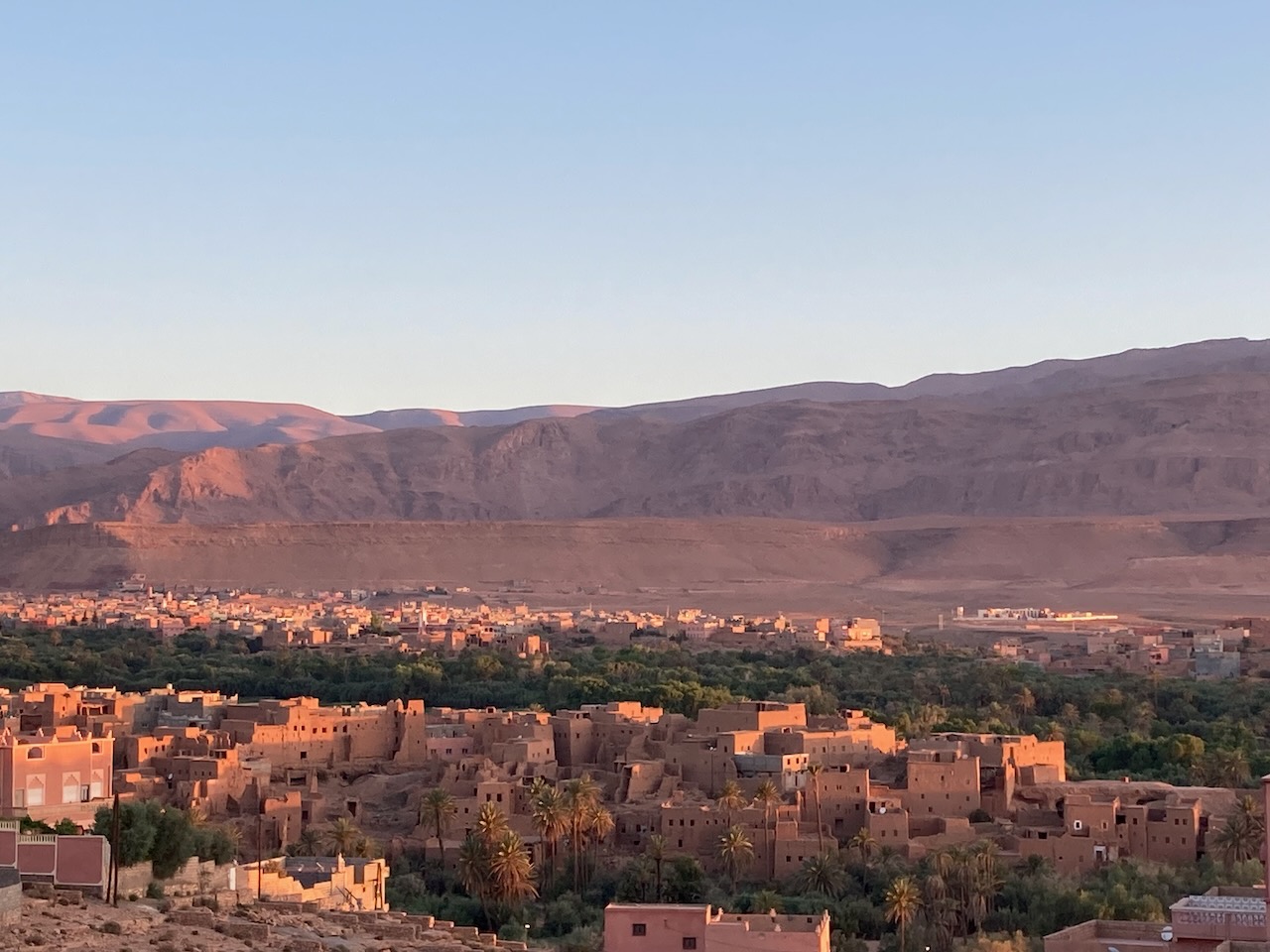
In May 2024, we went to Morocco to explore the cities, experience the culture and of course, for the rock climbing at Todra Gorge. It was a great trip. We enjoyed being immersed in this exotic, wondrous country. I’m glad we went but I’m not sure I would go back.
If you are considering a similar trip, the section below on Trip Planning might have some useful information. There is also a section on Cultural Considerations to help you know what to expect if you’re not familiar with Morocco.
And of course, there is a section below called Climbing, which includes photos and details about each of the four crags we climbed at Todra Gorge.
The Trip Planning and Cultural Considerations sections contain a list of headings you can scroll through to easily find exactly what you are looking for. The Climbing section includes general notes on gear and guidebooks as well as four Trip Reports, one for each crag we visited.
But first, here are some reasons that Todra Gorge is a great rock climbing destination but also some reasons why it might not be for everyone.
Reasons to Go to Todra Gorge to Climb
- Fun climbing on featured rock. Good routes that flow with interesting movement.
- Exotic culture / location – shepherds with their goats & donkeys, mint tea, fresh orange juice, mosques and call to prayer, markets. For more about the culture, scroll down to Cultural Considerations.
- The gorge is pretty cool – tour groups stop here everyday just to walk in the gorge and take it in. It’s a cool setting for climbing.
- Moroccan people are welcoming – especially in the area around the gorge, we found the local people were friendly and we enjoyed getting to know them.
Reasons Not to Go to Todra Gorge to Climb
This list is going to sound a bit whiny as I point out everything I did not enjoy about the climbing experience in Todra Gorge. But I’ll risk sounding whiny in order to give you the full low down about the place. No unpleasant surprises.
- A long trip – especially coming from North America, this trip involves long flights and brutal jet lag.
- A long drive and a crazy drive – we rented a car in Casablanca because we wanted to stay in Tinghir and drive to the different climbing areas in and around Todra Gorge. The drive from Casablanca was long and chaotic. See more about Driving under Trip Planning below. If you fly into Marrakesh, the drive will be almost as long and just as crazy.
- Garbage at the crags – So much discarded wrappers, paper, and plastic containers blowing around and stuck in bushes. In one place we found a plastic bag ripped open with a half-eaten watermelon hanging out. Not sure how long ago that picnic in the gorge took place but the uneaten watermelon was crawling with ants. We had to move the watermelon to set up our rope at the bottom of a climb.
- No bathroom opportunities at the crag – this may seem like a small thing until you’ve been climbing for a few hours and nature calls. There are no public facilities and no trees or bushes to hide behind. Then add crowds to get the full, uncomfortable picture.
- Crowds – the negative impact of this depends on your comfort level with being watched while you climb. The audience includes tourists and tour groups, and one morning, we were the subject of a tour guide’s chat to his group. One day a local guy hung out with us all morning even though we didn’t speak the same language and couldn’t really communicate (awkward). Other tourists approached us to find out more about the climbing. At times, locals approached us to see if we wanted to give them money, food or other items. You might not find this a negative but I’m used to climbing in the Canadian Rockies where the only other people we see at crags are climbers. It was different and, at times, uncomfortable for me.
Trip Planning
Here are a few pointers, based on my experiences, to help you plan your own climbing trip to Morocco, specifically staying in the city, Tinghir, and going to Todra Gorge. Click the triangle at the left of each heading to open more information about that topic.
When Not to Go
It felt like we arrived a little too late. I got the impression that most climbers go to Todra Gorge during the winter to escape cold conditions at home. When we were there, it was often too hot to climb except in the early mornings.
The guidebooks implied that crags could be crowded because they are close to the road and include easier climbs. They also described some crags as “nice and sunny” during certain times of the day.
However when we were there, we saw very few other climbers. No one seemed to be spending any length of time at the Gorge, perhaps a day or two of climbing on their way to somewhere else.

The heat when the sun hit the rock was almost unbearable. We planned our climbing days to start early and end around noon when the sun overhead started searing the crag.
Definitely May is too hot to really get into the climbing.
Fly to Casablanca or Marrakesh
There are international airports at Casablanca and Marrakesh. Marrakesh is a little closer to Todra Gorge and the drive is a bit nicer, with paved roads most of the way.
We chose to fly into Casablanca because we could get a direct flight from Canada (Montreal). We flew from Calgary to Montreal first. We rented a car and used Google Maps to navigate to Todra.
Driving in Morocco is not like driving anywhere else that I’ve been in the world. I thought Lima, Peru was chaotic. I thought Italy was fast. Put it all together and stir in a lack of any hard and fast rules-of-the-road and you’ve got Morocco. See “Driving” below for a complete description.
Driving
I wish I had taken a video of the driving in the cities. It’s hard to capture the full experience with words alone.
The road signs and even the painted lines for lanes and crosswalks are really just suggestions. You decide as you go.
Can you fit three vehicles into two lanes? Sure. Nearly rubbing the side view mirrors as you pass each other? That’s just part of the journey. Passing on solid lines? Of course. If the car in front is going too slow, you pass. If you can’t get by, then you honk until the car moves or speeds up.
I’ve seen cars drive in the middle of two lanes, taking up both. Why choose? There are no rules.
As you drive down the road, pedestrians may step into the street at any moment. Motorcycles buzz around taking the outside of your lane or the inside if they have to. Big trucks bomb around the corners doing double the posted speed limit.
And yet, there are no accidents. Everyone expects the unexpected and nobody is ever surprised. It’s a perfect symphony of chaos.
One day, driving through a busy market town on our way back to Casablanca, we slowed down for pedestrians and a donkey pulling a cart merged in front of us.
My husband Dan drove and navigated like a local. Incredible. I sat in the passenger seat laughing at the madness.

Outside the cities and towns, the roads were less busy but we encountered some interesting obstacles.
Hotels
There are many places to stay in Tinghir (also known as Tinerhir) which is the city closest to Todra Gorge. It’s about a 20 minute drive from the gorge. There are places to stay that are closer to the gorge but I was glad we were in the city. We had a lot more dining options and the market was a great place to shop for snacks and souvenirs. FYI, an “auberge” is an inn or small hotel.
Safety
We felt safe at all times in Morocco except for driving from Essaouira to Casablanca. The road was narrow and busy and the driving felt a bit dangerous.
Of course, we avoided certain areas of certain cities at night, just as you would avoid certain areas in most of the world’s cities at night. That’s just common sense.
We had no concerns about pick-pockets, on the streets or in the markets. We wore our backpacks on our backs (not clutching them against our chests as we saw some tourists doing) and we kept cash in our pockets with absolutely no concerns. It seemed like the locals did not want to steal our money. But some sure tried to talk us into giving it to them! (See “Walk-Up Guides and Offers to Help” under Cultural Considerations below.)
Languages
Most locals speak French and Arabic. Especially in the area around Todra Gorge, Berber is also spoken. It can be difficult, but not impossible to get by with only English. If you can speak a bit of French, you’re miles ahead.
Can You Drink the Water?
We drank bottled water. We didn’t drink the tap water but we weren’t too concerned about it. We brushed our teeth with it, we had ice cubes in our drinks, and we rinsed our fruit with tap water. Not a problem.
Full disclosure, we did get Traveller’s Diarrhea in Casablanca on our second or third day in Morocco. We blamed it on the fresh, raw oysters we enjoyed at the restaurant in our hotel. Oops. That beach is full of garbage!
How is the Food?
The food is great. It all tastes like home cooking – fresh and simple with very little processing.
One of our first days in Tinghir, I ordered grilled meatballs and got this big plate full. The veggies were very fresh. The fries seemed hand cut and were not greasy. The meatballs were nicely grilled.
When you sit for lunch or dinner, they always bring bread and olives.


Although couscous is the national dish of Morocco, we found the tagine was the most enjoyable dish. It can be made with any meat, or fish, and vegetables. It is slow cooked and spiced to perfection. Everything gets tender and juicy. There is always plenty of bread to sop up the juices. They eat most meals with fresh bread – so good.
Another great meal that is widely available is skewers or “brochette”. Here we enjoyed chicken brochette with fries, grilled onions and fresh tomatoes. In the back you see the ubiquitous bread and olives.


It seems like every restaurant in Tinghir has a grill out front, like the backyard BBQs at home. In the photo, the green umbrella provides shade for the cook as he grills whatever meat customers have ordered. On the right side of the photo, you can see tagines cooking in the small pots. Tomatoes or oranges are set on the top of the lids to warm.
This was our last day in Tinghir and, after eating everyday at Cafe Restaurant La Place, Dan decided to help out at the grill. The staff put an apron on him! Hired!
Breakfasts are usually European-style – croissant and coffee. They eat later than North Americans. Lunch is around 1 or 2 pm and dinner around 8 pm. Many restaurants close after lunch and do not open for dinner until 7:30.
How to Buy Groceries in Tinghir
In Tinghir, we wanted to stock our hotel room fridge with snacks, beverages and lunch items for climbing days. We drove to three different “supermarkets”. When we hit the “groceries” button on the Google map, these were the places that came up.
When we went to them, there was no produce, no bread or baked goods, no meat, no dairy products. It was mostly things like toilet paper and cleaning supplies as well as packaged snacks like cookies and chips.
The place to buy produce and snacks like nuts, dates and olives is from the stalls in the market. The bakery is also in the market. A full write up about the market in Tinghir is included under “Walk Up Guides and Offers to Help” below.
I would skip the dairy products in the stores. The “cheese” we bought was made from powdered milk mixed with vegetable fats. There just isn’t much of a dairy industry.
The fruit is so juicy and ripe and sweet. Apricots, nectarines, plums and peaches like I’ve never tasted before. At home, I think most fruit is picked before it is ripe and it ripens on route to the grocery store. It tastes sour and dull and flat compared with the fruit I got in Tinghir.
Restaurants will often serve a plate of fruit as dessert. It is sweet like candy.
You Need Dirhams
The currency in Morocco is the Dirham. You can exchange your Euros or USD for Dirhams when you arrive in Marrakesh or Casablanca.

Wafacash is one of many places you can go to exchange your money. Your hotel may also be able to exchange some for you at the front desk.
You Might Need WhatsApp
Many locals use WhatsApp for their phone number. If you want to contact them, you will need WhatsApp on your phone too.
Cultural Considerations
This trip was my first time in a Muslim country and also my first time in Africa. It was the most “different” place from Canada I’ve ever been. Below are some of my observations and things I wish I had known about Morocco before I got there.
Culture Shock
My husband Dan and I started our Moroccan journey in Casablanca. We hired a private guide to show us the city and we ended up learning a lot about Morrocan culture from him. I will share all of our learnings with you here but first, a look at life in Morocco as we first experienced it.
I took this photo of the city from our hotel, looking west toward the Atlantic Ocean.

Across the busy street is a long wall with arches in it. These arches house small shops and stalls selling clothes, jewelry, knick-knacks, teapots and glasses, household items and all kinds of stuff. They are empty in the photo because the shops are not open yet. The city starts and finishes later than at home. Most shops open around 10 am and are still open at 7 pm, closing later in the evening.
The tower in the distance is part of the Hassan II Mosque. It is the third-largest mosque in the world and the largest in Africa. In case you are unaware (as I was), a mosque is a church for Muslims. Muslims are people who practice Islam and it is the major religion in Morocco.
Behind the wall with arches, in the middle of the photo, is the old market or Old Medina. There are shops and residences there. If you zoom in on the photo above, you can get a sense of some of the buildings. It would sure be different to live there. Toto, we’re not in Kansas anymore!

Here is one of the gates in the wall with the arches. We wandered in on our first day, fresh off the plane from Canada.
Being in the market was a bit overwhelming.
There were crowded shops and stalls in every available space. Tables covered with items for sale were spilling out into the narrow lanes. Motorcycles and scooters were buzzing through, dodging the people and the tables.
The women in their long colourful Caftan dresses with scarves covering their hair shopped for the family meals. The sounds of Arabic were everywhere – it was rare to hear English.
And the smells! We were often smelling fish, urine, or garbage and sometimes a ripe combination of all three. Dan said at times, he had to breathe through his mouth! I didn’t because I didn’t want that smell in my mouth. (Note: during the course of our travels, we visited a few different markets in different cities and none of the others smelled like this one.)
The market had shops for each kind of item grouped together in one area. There was an area for clothing, an area for household goods and areas for fresh food. When we walked through in morning, all the fresh fish and seafood from that morning’s catch were arranged on beds of ice. There was fresh meat and even some live chickens for sale.
We walked toward the mosque which is right on the ocean. In fact, it was built over the ocean.

Children swim near the shore. The girls swim fully clothed in long-sleeved shirts and pants.
Girls and women typically do not show bare shoulders or knees. There is a lot of leeway for tourists and you won’t get in trouble if you wear shorts and a tank top but locals dress a lot more conservatively.
Find out more about how to dress in Morocco under “What Not to Wear” below.
We learned that most tourists here will take multi-day tours. They are not hear for the rock climbing! They meet in Casablanca, load into buses and drive to Fez and to the blue city, Chefchaouen, where they get off the bus for a designated time period, snap photos, sample tour-approved food and drink and then get back on the bus.
It sounded dreadful to us. But we did hire a guide for a tour of Casablanca which turned out to be very useful in getting to know the culture and customs. Our guide spoke English very well and taught us a lot about the city and life in Morocco.
The guide company we used is With Locals. and I booked online a couple of weeks before we left for Morocco.
We met our guide, Youssef, at a Catholic church. Yes, there are a few Christians here. Youssef says they are mostly South Africans. The congregation we saw entering the church seemed to confirm that. The local Moroccans look much more like people from the Middle East or Egypt and less like people from South Africa. They are lighter skinned with dark hair and lighter eyes. Youssef told us later that blue eyes like mine are rare and you would have to pay a lot for a wife with blue eyes.
By the way, did you know that Moroccan men can have more than one family? Apparently up to four is not unheard of. Youssef said it’s very expensive though to have so many families. I began to feel that gender-equality is not really a thing here.
The roles and responsibilities for men and women seemed a lot more rigidly defined than at home.
Walking past restaurants and cafes, I noticed the outside tables were typically occupied by men sitting side-by-side, drinking tea or espresso. But no women were there. I commented on this to Youseff and he said that men and women are mixing a lot more these days. It was hard to find evidence of that.
I wondered where the women went to have their tea or espresso. I imagined gardens in the middle of buildings with flowers and fountains and all the women sitting together there, enjoying tea in their own private paradises.
Youseff explained that Moroccan homes often have gardens on the inside. He said that the apartment buildings with balconies are French style, not Moroccan. They were built when the French occupied Morocco from 1912 to 1955.
The Moroccan people are very private and their homes are typically plain with few exterior windows and no balconies.

The windows have screens so you can’t see inside. Youseff explained that Moroccan men do not want their wives to be seen. The screens allow women to look outside and not be seen by people outside.
Also, it is not appropriate for a woman to answer her door if a man is knocking. Front doors have two places for knocking which make different sounds on the inside of the house. One place is for women to knock and the other is for men. If the wife inside hears the knock that indicates a man is calling, she does not answer.
We were touring an area of Casablanca called Habbous.

The market there was much cleaner than the old medina and actually smelled good. Imagine fresh-baked bread and meat grilling on the BBQ.
This is the area for shops selling olives. Youssef got us a free sample and those olives were very tasty. They grow abundantly in Morocco and are much less expensive than back at home.


Here Youssef (in the white shirt) is taking us through the area selling carpets. He said there is an auction here every day after the midday prayers.
Here a butcher is selling camel and other meat. At the far right is ground camel spiced with herbs. The hanging piece of white on the left is a camel hump. On the left, beside the sausage links are camel internal organs.
(Note that these animals are technically called dromedaries, not camels. Real camels have two humps, not just one like these. But everyone referred to them as camels, not dromedaries so I’ll stick with that nomenclature.)


Here are some larger chunks of meat including lamb and yes, that is the camel’s head.
You may be wondering if we got a chance to try any camel meat. The answer is YES! Youssef helped us buy some ground camel and internal organs (heart, lungs, liver) and a few thin slices of the hump. Then we took it across the lane to a restaurant that grilled it for us.

We had tomatoes and onions and a big piece of flatbread to eat it with. The ground camel was good. Much like a nice pork sausage with mild herbs and spices. They cooked it like a big hamburger patty on a grill.
The internal organs were hard to eat. We are not used to the texture. It seemed like clay in my mouth. The flavour wasn’t bad but I had a hard time chewing it up. Dan could not eat it either. But Youssef loved it and took the leftovers home to his wife and two kids.
Fun fact, in Morocco, they do not use forks. They use the bread to scoop up meat and veggies. They must eat with their right hand only, never the left. Youssef mentioned there was a religious reason but I didn’t learn any more about it.
Don’t worry about trying to eat this way, restaurants will always give you a fork.
After three hours of exploring and a hearty lunch it was time to say good-bye to Youseff. He gave Dan a big hug and pat on the back. I got a quick hand-shake. I didn’t feel bad though. According to Youseff, Moroccan men and women who are not related do not touch each other. He stepped out of his cultural norms to shake my hand.
After such a rich, informative tour on our first full day in the country, we thought we were prepared for anything. We were wrong.
Walk-Up Guides and Offers to Help
We were surprised at how helpful some of the locals were. Then we realized they were expecting to be paid.
When someone comes up to you and offers to help you find a place you are looking for or an item you are shopping for, understand that they believe you are going to pay them for this service. If you understand this up front, it can be a very positive experience.
We had a fantastic experience in Tinghir with a fellow who offered to help us find sunscreen as we were shopping at the market. I was going over our shopping list with Dan and Mohammed introduced himself and said he could show us where to buy the sunscreen. He was very fluent in English and he was friendly without being pushy.
We followed Mohammed into the market. There was a huge stall with crates of dates. I had tried a date in Casablanca and it was very good. I stopped at the stall. Mohammed translated for us and the guy selling dates offered to let us try one for free. It was so good! Sweet like sugar. We bought a box. Dates are a great snack for rock climbing in Morocco.
Mohammed explained how the market in Tinghir differs by day of the week. One day, there are clothes for sale, another day, household items. So people shop for what they need by day.
I have to tell you, it felt pretty local. There were no tour buses. Everyone looked like they lived in the area and shopped there regularly.
He took us to buy some fruit. With him translating at the fruit stands, we got free samples of apricots and plums. I have never tasted fruit like this. It must have ripened fully on the trees and been picked very recently. So sweet and juicy and the flavour was intense. I can’t buy fruit like that at home. And the prices were so low it was unbelievable.
Then Mohammed said, “You want bread, right?” Yes. He took us to a little bakery tucked in between two market stalls. There are no store signs, we never would have found it without him. We got a huge round loaf of bread for about $0.30 Canadian. Local shop, local prices. Brilliant.
Next we wanted to buy beer. It can be hard to find in a Muslim country. Mohammed knew a place. It was a bar in a hotel and they were willing to sell “off sales” so we could take the beer with us to our hotel. Again, we would not have found it without Mohammed.
When he took us to a store for sunscreen, they had face cream but not sunscreen. He realized then what we were looking for. He said we would have to get it in a pharmacy but most of the pharmacies are closed on the weekend. We told him not to worry about it, we’d pick some up on Monday.
As we shopped with him, we learned a bit about Mohammed. His family owns a local restaurant and he was hoping we would have lunch there. Of course we did. A wonderful chicken tagine (roast chicken in lemon gravy) with french fries, bread and olives with two cokes cost about 10 dollars total for two of us.
Dan thanked Mohammed with a cash gift. He had helped us out so much. Mohammed was very appreciative of the gift.
We sat a long time over lunch, talking about how much we liked this town, Tinghir. It felt a lot more real than Casablanca. More relaxed and laid back.
When we were finishing lunch, Mohammed returned. He had found a pharmacy that was open. He walked us over to it. Sure enough, they had sunscreen.
Then Mohammed pointed out a shop selling scarves. We wandered over and he introduced us to the lady working there. Her name was Fatima and she hand-stitched all the scarves. I admired her work and she put one on me.
I thought of the kids I had seen on our drive from Casablanca, chasing the car with their hands out. Buying a scarf felt like a good way to contribute to the lives of people living with less. So I bought the scarf she chose for me. Outside the store, Mohammed thanked us for buying a scarf. He said it was really helpful for Fatima.
We wandered with Mohammed down narrow streets through the Jewish Quarter. We would never have found these areas by ourselves. We saw community gardens where every family has a plot to grow their food.
Then Mohammed invited us into a shop with rugs hanging on the wall. The Berbers are famed for the quality and beauty of their hand-made rugs.
Mohammed introduced us to the man in charge there. He led us down a hall. At the end of the hall, we were asked to take off our shoes. We entered a room with rugs on the floor, rugs hanging on the walls and a loom at the end. Around the side of the room were cushions to sit on. A lady sat on a cushion near the loom pulling wool between two spiked cards. I was asked to sit beside her and Dan sat across from me. The lady was the wife of the man in charge. It was the family’s rug-making business.

They showed us the entire process of making the rugs starting from the wool. They use wool from sheep, lambs and dromedaries. The baskets of lamb and sheep wool are in the photo above on the left side.
The wool is from their own animals which are out in the hills with the men of the family. They are about 150 km north of the Gorge. I thought of the shepherds we had seen in the hills with their flocks when we drove from Casablanca. We learned that they harvest the wool from the animals once a year.
They also create yarn from cactus. It is dried and then the fibres inside are softened.
After the wool is spun into yarn it is ready to be dyed. They use local plants and minerals for dye. Saffron for yellow, poppies for red. The red rug on the floor in the photo above was made by the man in charge’s grandmother 45 years ago. They have techniques for ensuring the dye doesn’t fade. The quality of the yarn and the hand-weaving technique ensure that the rugs last for many decades.
At one point, the man’s aunt came in and sat with us. Then a young lady brought mint tea. The man in charge served us tea and introduced the young lady as his daughter.
He asked if we had any sons. I said yes. He asked if they were grown up. I said yes. He said perhaps a match could be made with his daughter. I said she would be perfect for our youngest son, Adam.
The man translated our conversation for his daughter, informing her that he had made a match for her. She was so embarrassed! She hid her face in her skirt. Finally, she spoke quietly to her dad.
He told us she said she would have to see Adam first. Fair enough, I said. With him in Canada, there would be no way. Some things aren’t meant to be, I guess.
We then went to another room with a larger loom and many more rugs. After learning about how the rugs are made and seeing the quality and the beauty, we decided to buy one.
The man in charge started bringing in rugs to show us. He explained what each rug was made of and what some of the symbols on them meant.

We finally decided on this one. It is made from dromedary wool and cactus. Some of the symbols are protection symbols and some stand for the 4 seasons and the Atlas Mountains.
I made a nice connection with the woman of the house, even though she spoke little English.
They were such kind and funny people. At one point, Dan said the to man, “Your wife works very hard.” She was pulling the wool through the cards the whole time we were talking. The man said, “Yes, she does, but she eats a lot.” Then he translated what he said for her and she laughed too.
What an amazing experience. I feel so privileged to have been invited in to share tea with those people and learn about their business which has been a way of life for their family for generations.
Our experience with Mohammed was very positive and we certainly felt the money we gave him was very little compared with what we got out of his informal tour.
But in Marrakesh, we had some unpleasant experiences with people who offered to help us.
In Marrakesh we had booked a hotel in the Medina. We were trying to drive there through the narrow streets full of motorcycles, pedestrians and carts when a boy, maybe 12 years old, tapped on the car window.
He spoke English well and asked where we were going. He told us he knew where our hotel was and offered to show us. We gladly accepted his kindness and he proceeded to run down the narrow lanes in front of the car, frequently looking back to ensure we were following.
After about 10 minutes and a long stop to catch his breath, we told him it was ok, we’d find it ourselves. We offered him a few coins as a thank you. He took the coins and said, “but this is nothing.” He looked so disappointed. Ok, fine, we gave him all the coins we had but he said, “no, this is nothing.” He stood waiting for more. After explaining that we had no more to give him, we drove on. He seemed very sad.
We continued our drive through the busy streets trying to follow Google maps which seemed to be sending us in circles or down alleys and walkways that were too narrow for the car. We were getting pretty frustrated and thinking we would have to park and find the hotel on foot.
A man on a moped offered to help us and, although we knew it would cost us, we agreed. We would gladly pay for an escort to the front door of our hotel.
We followed him as he drove, not to our hotel, but to his friend’s pay-for-parking lot. After we’d taken our ticket and parked, cursing and deciding to walk to our hotel from there, the man tapped on the window to ask for money.
We gave him a generous 200 Dirhams (about 20 Euros) and he asked for more. He leaned into the car through the open window and insisted he needed more. We reluctantly gave him another 100 Dirham, just to make him go away, and he said 100 more would be good. We refused. We decided we would sit there all day if we had to but this guy was not getting any more. Finally he left.
We left the car and used Google to look for our hotel on foot. We finally found it and as we were getting checked in, a helpful bellman took our car key and got our car for us, bringing it and our luggage to the hotel. What a relief!
The negative experiences were in Marrakesh, where there are a lot more tourists, and I think the cost of living is a lot more than in Tinghir. We did meet shop owners and sellers in Marrakesh that were cordial and genuine.
Religion
The main religion in Morocco is Islam. In case you’re as unfamiliar with this religion as I was, it helps to know that people who practice Islam are called Muslims and churches are called mosques.
Muslims pray 5 times a day. 1 – before sunrise, 2 – at midday, 3 – at 4 pm, 4 – after sundown, 5 – later at night, typically about 2 hours after sundown.

Each mosque has a tall tower called a minaret. A “call to prayer” is broadcast from the top of the minaret five times each day which reminds the faithful to pray.
We were told by one local that the three spheres at the top of the minaret represent three religions – Islam, Christianity and Judaism. We were told that Muslims accept and respect other religions.
I enjoyed hearing the “call to prayer” sung out over the towns and cities in many places I visited. Although I didn’t understand the words, it reminded me that life is sacred and I felt grateful to be on this journey.
What Not to Wear
Muslim people in Morocco dress more conservatively than people in Canada, the United States and Europe.

Local women wear loose clothes, typically long dresses, that cover their shoulders, arms and legs and hide the contours of their bodies. They often wear head scarves that cover their hair.
The most conservative women also cover their mouths and noses so only their eyes can be seen. These women also wear gloves to cover the skin of their hands. Consider this before you choose to walk around in a tank top and short shorts.
Men may show more skin but the local men rarely wore shorts or tank tops.
As a visitor in Morocco, you do not need to dress like a local but I think, as a citizen of the world, it is good practice to learn about and respect local customs when you are travelling in countries with different cultures and religions.
I saw a lot of visitors with short skirts, shorts and sleeveless tops or tank tops. They didn’t get into trouble and nobody harrassed them.
But people who choose to dress the same everywhere in the world as they do at home, with no consideration of local customs and expectations, either couldn’t be bothered to learn about the local culture or just don’t care how they are perceived by the locals.
I tried to be a respectful visitor. I dressed in baggy, loose clothes that covered my knees and shoulders. I wore either baggy pants and a loose top with sleeves or a long dress I purchased in Casablanca.
That being said, a climbing harness does make it impossible to hide all the contours of your body. I climbed with long, loose pants and a t-shirt that covered my shoulders. It was the best I could do to respect the local culture while climbing.
Stray Cats and Dogs
There are cats all over Morocco.

They roam the streets, sleep in alleys and even wander through outdoor restaurants, sometimes begging for food.
I could never figure out if people owned the cats. Most were mangy and dirty – they looked like they lived on the street full-time. But people put out food and water for them.
When we saw a dead rat on the street in Casablanca, I realized that the cats are probably doing a good service keeping the rodent population in check.
There are stray dogs in Tinghir, Todra Gorge and in most rural areas we drove through. It wasn’t uncommon for a dog to walk by the crag as we were climbing. They weren’t aggressive but we didn’t interact with them. Dogs in Morocco can have rabies and, like the cats, they were typically dirty and rough looking.
Alcohol
Muslims do not drink alcohol so it is not widely available. Most restaurants do not serve it.
We were able to have a beer or glass of wine at our hotels, which catered more to Europeans and North Americans. They also served cocktails. Word of advice, if you like cocktails, order the Mojito. Made with fresh local mint, it is usually the best.
Despite it’s Muslim majority, Morocco does have a wine industry which produces red, white and grey wines. Grey wine (vin gris) is uniquely Moroccan. If you enjoy wine, I recommend it.
People in Need
In Tinghir and near the Gorge, people ask for money. They rub their thumb and index finger together and then open their hand, palm up, toward you, hoping for something.
At first, I wanted to help everyone. What’s 10 or 20 Dirhams to me when these people have so little?
Eventually, I decided I didn’t want to give money out to everyone who asked. We were getting approached multiple times each day we were there and not always by people who seemed in need.
For example, we were walking to the market from our hotel one day when we passed a group of three women. They were chatting happily to each other and looked well-dressed in the local-style gowns and head scarves.
I smiled at them and they smiled back and said “bonjour”. I said “bonjour” and one of the women stuck out her hand for money. It seemed almost like an automatic reaction. See a tourist, ask for money. I shook my head, no, and they continued walking and chatting.
People also approached us while we were climbing. On our first day, a young man came over to watch us climb. That wasn’t strange, other people had walked by and some stopped to watch us.
But this young man stayed. He tried to talk with us but he spoke no English and only a little French.
The young man was very friendly and he offered to take a photo of us together. I wasn’t sure if he wanted money. He never asked for any and we never gave him any.
When we sat to eat, we offered him one of our breakfast buns and he took one and thanked us. He sat and ate with us.
He was very friendly to me and showed me photos on his phone of him climbing a mountain with snow on top. So he had some climbing experience. Maybe he just wanted to understand rock climbing a little more or he had nothing better to do that day. I’ll never know.
When we were finished climbing, I managed to tell him in French that it was too hot and we were done. He followed us back to our car. I wasn’t worried for our safety but it was weird and I felt awkward.
Some of the people at the Gorge seemed a little more in-need. The children in particular were hard to refuse. I started packing bigger lunches on our climbing days. When someone would come for a handout, I’d give them food instead of money.
I like to buy local crafts and locally made products. In Tinghir, we didn’t haggle much even though we know that’s expected. I wanted to put some money into the local economy. It felt like a way to give something to the community.
Climbing
We climbed six days in total at four different crags. We only did single pitch, no multi-pitches. All the multi-pitches I looked at had some long pitches that would need double ropes to rappel and we only had our 70 meter single.
Gear
All of the routes we did were considered Sport routes. They were bolted and the anchors were bolted. We brought about 14 draws (some routes are long) and standard belaying and rappeling gear. Some of our draws were alpine draws that can be extended. Routes were not terribly wandering but in a few instances, there were traverse sections where we used extended draws to reduce rope drag.
At certain crags, we wanted other gear.
Summer Gardens – the bolting was great on the bottom of the routes but near the top, some of it felt a bit run out. We were glad to have a couple of Kong Panic Draws that allowed us to reach up and clip the next bolt from a much lower stance than a standard quickdraw.
Summer Gardens – some of the routes were long and we needed every bit of our 70 meter rope.
Rock Gardens – bolting was a bit sparse here compared with what we’re used to at home. I was wishing for some trad gear (cams particularly) as there would have been decent placements and I would have felt more secure with more pro.
Climbing Shop
There is a climbing shop in the village next to the Gorge. When we went in, the person working there spoke English. We bought our guidebook there. There is gear for sale and for rent.
One day when we were out climbing, we met someone from Toronto who rented all the gear she needed to spend a day rock climbing with a guide while her travelling companions went hiking.
Guidebooks
We ordered the Todra book published by Oxford Alpine Club before we left. This helped us plan. When we arrived at Todra Gorge, we purchased the local guide book. We found it useful to have both books. Some information is in the Oxford book that is not in the local book and vice versa.
Some folks online have pointed out that the two books are not in total agreement about some of the grades and even some of the names of climbs and areas. That’s ok. It would be best if you took all the grades as approximations anyway. I imagine people from all over the world have come here and given opinions about what the grades should be. There’s bound to be inconsistency. Based on maps and photos, you’ll be able to figure out where the climbs and crags are. Mountain Project is also helpful. The names on Mountain Project are generally consistent with the local book.
The Rock
I enjoyed the rock climbing at Todra Gorge.

It is featured in many sections with ledges and pockets.
Some sections feature sticky slab. The rock is generally good quality and the routes we climbed were clean with no loose holds or features.


I feel like I have shared a lot of information on this page but there are bound to be things I missed or didn’t think to mention. If you would like more information, please feel free to contact me on the Contacts page.
If you have climbed at Todra Gorge, I would love to hear about your experiences. Please share your stories in the comments box below.
I look forward to hearing from you!
Leave a Reply